Comment choisir le bon onduleur pour pompe solaire HOBER : Guide de sélection complet
Choisir le bon onduleur pour votre pompe solaire, qu'elle soit destinée à un puits profond ou à une pompe de surface, est essentiel pour la longévité du système et l'efficacité du débit d'eau. Chez HOBER, avec 16 ans d'expérience en R&D et en fabrication, nous suivons un principe d'ingénierie fondamental : La puissance de l'onduleur doit être supérieure ou égale à la puissance de la pompe.
Dans la plupart des cas, nous recommandons de choisir une taille au-dessus pour une stabilité optimale du système. Voici notre guide professionnel étape par étape pour faire le bon choix.
1. Vérifiez les paramètres de base de votre pompe
Avant de choisir un onduleur, vérifiez les trois points clés suivants sur la plaque signalétique de votre pompe :
- Pouvoir: Mesuré en watts (W) ou en kilowatts (kW).
- TensionLes pompes monophasées fonctionnent généralement en 220 V/240 V ; les pompes triphasées fonctionnent généralement en 380 V/400 V/440 V.
- PhaseEst-ce un système monophasé ou triphasé ?
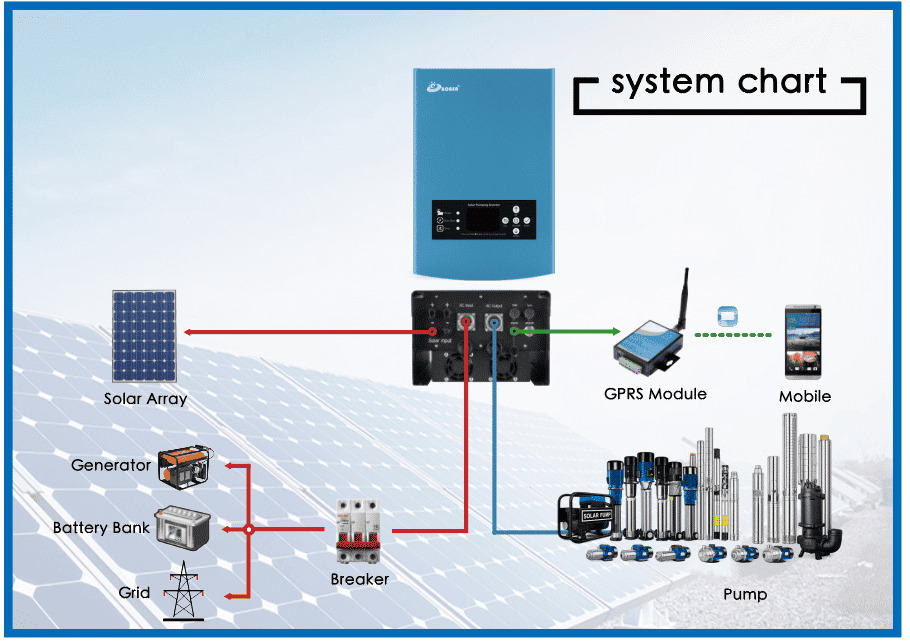
Figure 1 : Comprendre comment l'onduleur s'intègre dans le système de pompage total.
2. Comprendre la nomenclature du modèle HOBER
Nos numéros de modèle suivent la règle : HSPH-XXXX-H/LB
- HSPHOnduleur hybride pour pompe solaire (prend en charge l'entrée solaire et CA).
- XXXXPuissance nominale. Les nombres sans " K " sont des watts (ex. : 2200 = 2200 W) ; avec " K ", ils sont des kilowatts (ex. : 11KH = 11 kW).
- H/L: Type de tension. H pour triphasé (380 V+), L pour monophasé (220 V).
- B (Facultatif): Intégré Amplificateur. Les modèles comportant un " B " permettent un appariement précis de la puissance (rapport 1:1) sans qu'il soit nécessaire de " surdimensionner " l'onduleur.
3. Règles de sélection fondamentales
Selon les normes d'ingénierie des experts de HOBER, la sélection doit suivre cette logique :
La règle du pouvoir
Votre objectif est de satisfaire : $\text{Puissance de la pompe} \le \text{Puissance de l'onduleur} \le 1,2 \times \text{Puissance de la pompe}$.
- Modèles standardChoisissez le modèle dont la puissance est immédiatement supérieure à celle de votre pompe. Par exemple, pour une pompe triphasée de 4 kW, choisissez le modèle suivant : HSPH5500H (5,5 kW).
- Modèles Booster (" B ")Si l'onduleur comprend un amplificateur intégré, vous pouvez obtenir une correspondance de puissance exacte de 1:1.
Correspondance des types
- Pompe monophasée (220 V): Doit utiliser un Type L onduleur (par exemple, HSPH2200L).
- Pompe triphasée (380 V+): Doit utiliser un Type H onduleur (par exemple, HSPH3700H).

Les variateurs de fréquence Hobertek sont conçus pour supporter les couples de démarrage élevés des pompes industrielles.
4. Considérations relatives aux pompes de puits profonds et aux pompes de surface
Bien que la puissance électrique soit le principal facteur déterminant, l'environnement d'application compte :
Pompes pour puits profonds
Les puits profonds nécessitent une pression de refoulement élevée et des charges de démarrage importantes. Nous recommandons vivement… ""Une taille au-dessus"" règle visant à garantir un couple de démarrage suffisant.
- Conseil de proSi la longueur de votre câble dépasse 150 mètres, nous vous recommandons d'ajouter un réacteur ou filtre de sortie à la sortie de l'onduleur pour protéger l'isolation du moteur.
Pompes de surface
Pour les pompes de surface (comme les pompes multicellulaires horizontales ou verticales), le mode MPPT est souvent mieux réglé sur mode PID lors de la mise en service pour un fonctionnement plus fluide.
5. Exemples de sélection rapide
| Paramètres de la pompe | Onduleur recommandé | Logique |
|---|---|---|
| 1000W Monophasé (220V) | HSPH1500L (1,5 kW) | Prochaine puissance monophasée disponible supérieure à 1000 W. |
| 2,2 kW triphasé (380 V) | HSPH3700H (3,7 kW) | Prochaine taille triphasée disponible pour plus de stabilité. |
| 15 kW triphasé (380 V) | HSPH18.5KH (18,5 kW) | Il est recommandé de choisir une taille au-dessus pour une stabilité optimale à haute puissance. |
| 750 W monophasé (220 V) | HSPH750LB (750W) | Le booster " B " permet une correspondance exacte 1:1. |
6. Configuration environnementale et solaire
- AltitudeSi votre projet se situe à plus de 1000 mètres d'altitude, la raréfaction de l'air réduit l'efficacité du refroidissement. doit Réduisez la puissance de l'onduleur (choisissez une puissance nominale nettement supérieure).
- Dimensionnement des panneaux solairesPour garantir le bon fonctionnement de la pompe même en cas de faible luminosité, la puissance totale de vos panneaux solaires doit être d'environ 1,5 fois la puissance de la pompe.
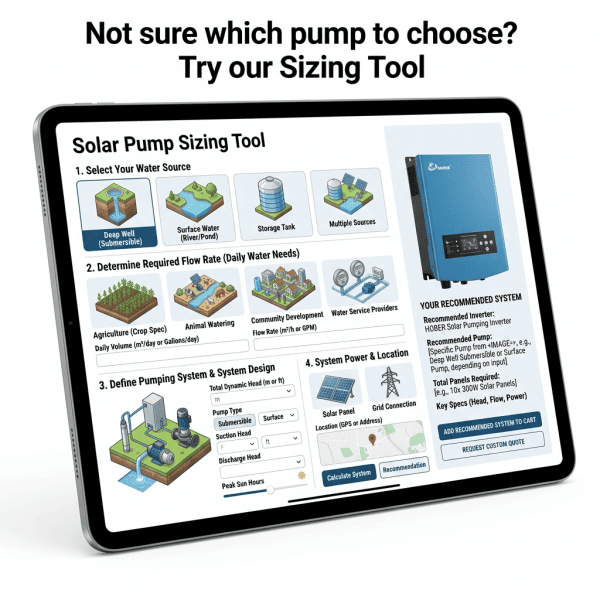
Ne devinez pas — utilisez notre outil de mesure professionnel pour trouver la taille parfaite.
Besoin d'aide pour votre projet spécifique ?
En tant que fabricant certifié ISO9001, HOBER propose des évaluations techniques gratuites et des solutions de conception personnalisées. Contactez notre équipe d'ingénieurs dès aujourd'hui pour obtenir votre personnalisation Lettre d'estimation.